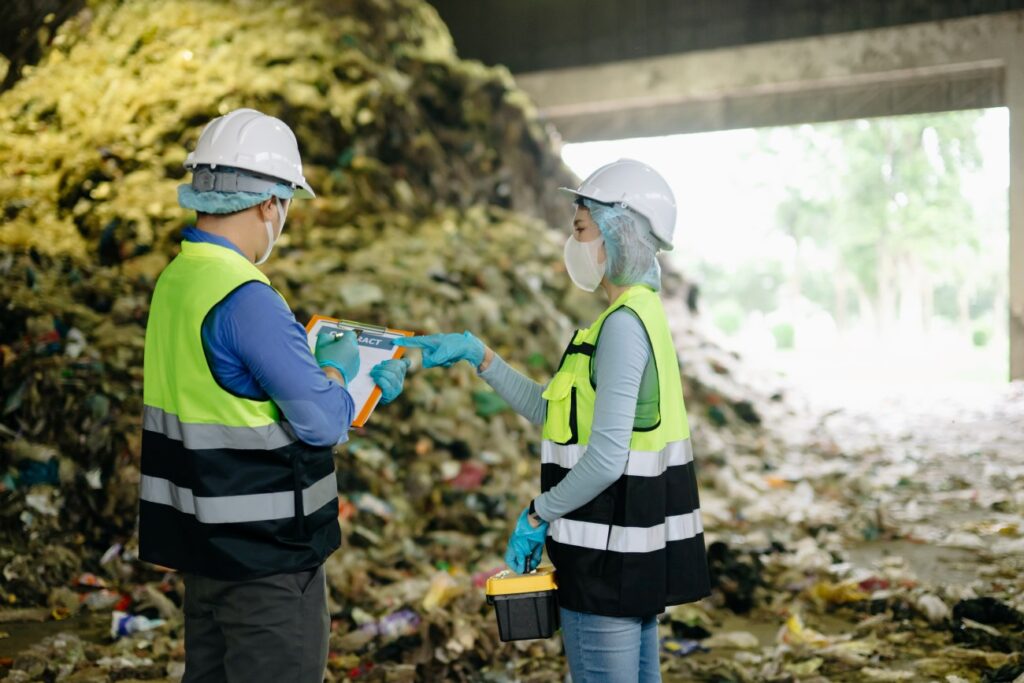
Special management waste includes, among other things, wastewater treatment sludge, construction waste, process plastics and metals, industrial containers and packaging, scrap tires, food industry waste, and textiles.
The distinction that most often leads to inspection findings is this: waste is considered special management waste only when it can be shown to be non-hazardous. Sludge from an industrial treatment plant or waste from a chemical process must be characterized under NOM-052-SEMARNAT-2005 before it can be classified as SMW. Without that analysis, the classification is only an assumption, and the authority may treat the material as hazardous waste.
2. Who Must Have a Waste Management Plan?
The key criterion for SMW is whether a facility is a large generator: a generator that produces 10 metric tons or more of waste per year (Article 5 of the LGPGIR). Large generators of SMW must prepare a waste management plan (Article 28 of the LGPGIR). NOM-161-SEMARNAT-2011 establishes the criteria for classifying SMW, lists the waste streams subject to a management plan, and specifies the elements the plan must include.
One important clarification: the microgenerator category—up to 400 kg per year—is defined by law for hazardous waste, not for SMW. Applying it to SMW can lead to incorrect conclusions about what a facility must register. State laws may also require additional registrations from any generator, regardless of volume. The federal threshold is therefore a starting point, not the whole answer.
At a minimum, a useful waste management plan that can stand up to an inspection should explain:
- Which SMW streams the facility generates and how they were characterized.
- How much of each stream is generated annually, using figures that match the manifests and service provider invoices.
- What reduction, reuse, recycling, or recovery measures are in place.
- Which service providers are involved at each stage and what authorizations they hold.
- How contingencies are handled and which indicators are used to monitor performance.
3. Guanajuato and Yucatán: Same Federal Framework, Different State Requirements
The LGPGIR applies nationwide, but each state decides how to implement it. The same waste may require different filings depending on where it is generated:
The generator’s responsibility does not end when the waste leaves the facility. If the transporter or final disposal site operates without authorization, the generator may still be held accountable by the authorities. Periodically checking each provider’s registry status or authorization—not just at the time of hiring—is a way to protect the operation legally.
4. Environmental Licenses: Three Similar Names, Three Different Permits
Confusion among environmental licenses is one of the most common reasons for filing the wrong paperwork. These are three separate instruments:
A facility may need more than one license. For example, an automotive plant in Guanajuato with a federal LAU for processes under federal jurisdiction must also manage its SMW with the state authority. In addition, holders of a federal LAU must file the Annual Operating Certificate (COA) with SEMARNAT.
5. Common Findings During Facility Inspections
During reviews of industrial facilities, SMW gaps rarely stem from missing documents. More often, the documents do not accurately reflect the operation:
- Inconsistent volumes. The waste management plan reports one amount, while the manifests or service provider invoices show another.
- Expired service provider approvals. The provider was listed in the registry when hired but did not renew its registration, and no one checked again.
- Unsupported classification. Sludge or process waste is handled as SMW without characterization to support that classification.
- Outdated license. After an expansion or process change, the license still describes the facility as it operated before.
Facility checklist
- Inventory all waste streams and classify them under the LGPGIR and the applicable state law.
- Support the classification of any process waste handled as SMW with CRETIB characterization.
- Determine whether the facility is a large generator (10 metric tons or more per year) and whether its SMW appears on the list in NOM-161-SEMARNAT-2011.
- Reconcile the volumes in the waste management plan with service provider manifests and invoices.
- Verify every quarter that all service providers remain listed in the registry or hold current authorization.
- Confirm which license applies to the facility (federal LAU, state LAU, or LAF) and make sure it reflects current operations.
- Check whether the state has aligned its legislation with the General Law on Circular Economy.
Conclusion
Managing special management waste comes down to consistency: between what the facility generates, what it reports, and what it can prove. With the General Law on Circular Economy now in effect, that consistency will become more than a state requirement; it will also be information requested by federal authorities, customers, and corporate headquarters.
Sources
- Cámara de Diputados, Ley General de Economía Circular y reformas a la LGPGIR, DOF 19-01-2026
- LGPGIR, Cámara de Diputados
- NOM-161-SEMARNAT-2011, Secretaría de Economía
- Gobierno de Guanajuato, PAPSRME
- Gobierno de Yucatán, trámite SDS00-2490
- LGEEPA, art. 111 Bis, Cámara de Diputados
- SEMARNAT, Cédula de Operación Anual
- Cámara de Diputados. Ley General de Economía Circular. DOF, 19 de enero de 2026.
- Cámara de Diputados. Ley General del Equilibrio Ecológico y la Protección al Ambiente, art. 111 Bis.
- SEMARNAT. NOM-161-SEMARNAT-2011, criterios para clasificar los residuos de manejo especial y determinar cuáles están sujetos a plan de manejo. DOF, 1 de febrero de 2013.
- SEMARNAT. Cédula de Operación Anual.
- Gobierno del Estado de Guanajuato. Ley para la Gestión Integral de Residuos del Estado y los Municipios de Guanajuato y sus reformas, incluido el Decreto Número 178 publicado en el Periódico Oficial el 26 de junio de 2025.
- Gobierno del Estado de Guanajuato. Padrón de Prestadores de Servicios para el Manejo de Residuos de Manejo Especial (PAPSRME).
- Gobierno del Estado de Guanajuato. Reglamento Interior de la Secretaría del Agua y Medio Ambiente.
- Gobierno del Estado de Yucatán. Ley para la Gestión Integral de los Residuos en el Estado de Yucatán, arts. 26 a 28, y su Reglamento, art. 52.
- Secretaría de Desarrollo Sustentable de Yucatán. Evaluación y Resolución de Licencia Ambiental Única (homoclave SDS00-2490).