In Yucatán, heat is predominantly humid. High relative humidity reduces sweat evaporation, the human body’s primary cooling mechanism. In many industrial buildings, this is compounded by radiant heat from metal roofs, furnaces, motors, or hot surfaces—and sometimes by convection from stagnant air.
By contrast, heat in northern regions and the central plateau is often drier. Even when dry-bulb temperatures are equal to or higher, lower relative humidity allows more efficient evaporation and, therefore, a lower physiological heat load at the same temperature reading. This difference explains why the same WBGT value may represent different levels of risk depending on the region. It also explains why control programs cannot be automatically transferred from one climate zone to another.
2. From Discomfort to Heatstroke: Stages of Heat Stress
Heat stress does not usually appear all at once. It tends to progress through recognizable stages:
- Thermal discomfort and fatigue: Excessive heat, heavy sweating, reduced concentration, and lower performance.
- Heat exhaustion: Weakness, dizziness, nausea, rapid heartbeat, and cool, clammy skin. At this stage, the worker can still sweat.
- Heat cramps: Painful muscle contractions associated with electrolyte loss.
- Heatstroke: A dangerous increase in core body temperature, generally above 40 °C, along with altered mental status and hot, dry skin or residual sweating. This is a medical emergency.
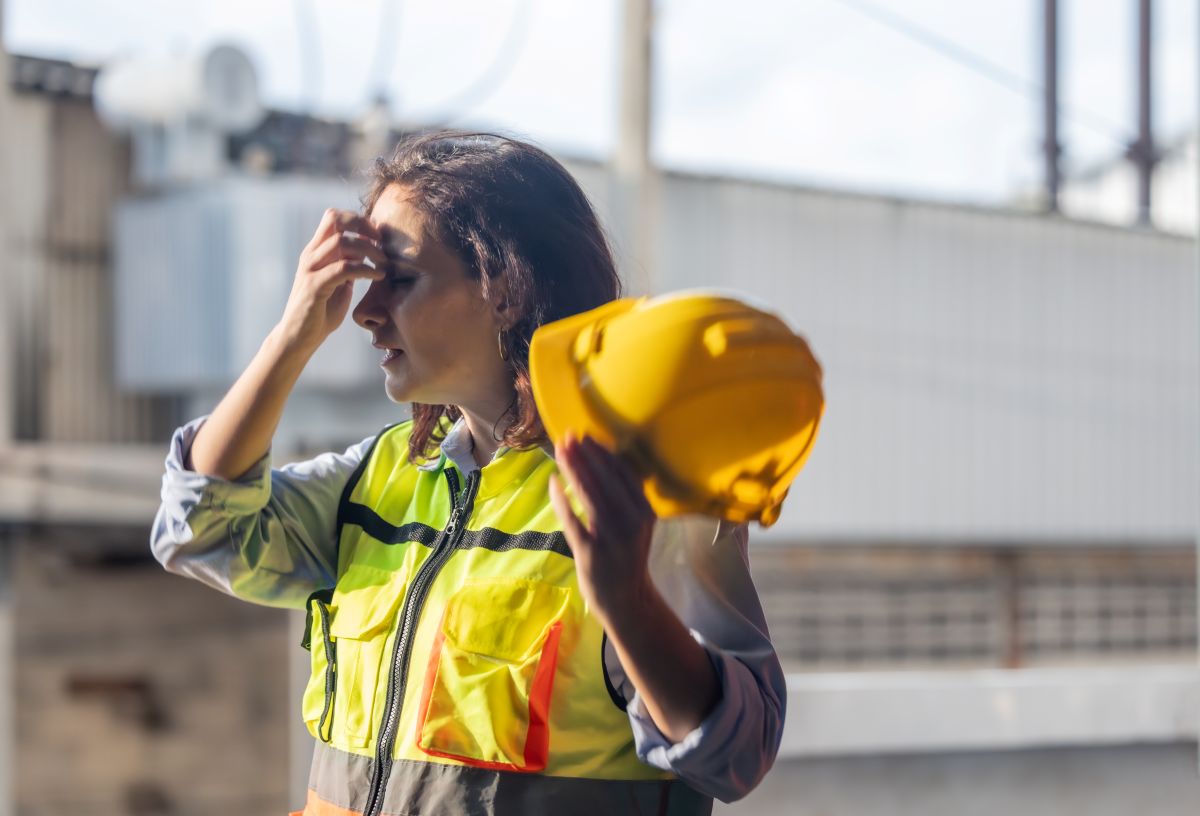
Recognizing these stages makes early intervention possible. NOM-015-STPS-2001 also states that a worker’s axillary temperature must not exceed 38 °C. If it does, immediate control measures are required.
3. The WBGT Index and Its Official Application
The standard uses the Wet-Bulb Globe Temperature (WBGT) Index as its reference method. This index combines:
- Natural wet-bulb temperature, which is influenced by humidity
- Globe temperature, which reflects radiant heat
- Dry-bulb temperature, for outdoor conditions with solar load
Official formulas:
For indoor environments or outdoor environments without solar load:
For outdoor environments with solar load:
When conditions are not uniform at different heights, measurements are taken at the head, abdomen, and ankles, using this weighted average:
This weighting—approximately 10% for the head, 70% for the abdomen, and 20% for the ankles—is intended to represent the body’s thermal load more accurately.
WBGT results are interpreted according to the work rate—light, moderate, or heavy—and the percentage of time spent working versus recovering. Correctly classifying homogeneous areas and tasks is just as important as taking the instrumental measurements.
4. How NOM-015-STPS-2001 Is Applied in Practice
A technical assessment follows a clear sequence:
- Identify exposed workers and areas with similar exposure conditions.
- Determine the work rate based on estimated metabolic demand.
- Take measurements with calibrated instruments for dry-bulb temperature, natural wet-bulb temperature, and black-globe temperature, at the required locations and heights.
- Calculate WBGT using the applicable formulas.
- Compare the results with the standard’s maximum permissible limits.
- Define control measures and, when applicable, an acclimatization program.
- Prepare complete documentation to demonstrate compliance to the authorities and during customer audits.
The assessment should be traceable and, preferably, supported by an accredited laboratory so the results can support both internal decisions and external reviews.
5. Control Strategies Based on the Hierarchy of Controls
Once the risk has been characterized, control measures should follow the traditional hierarchy of controls, prioritizing those that eliminate or reduce the risk at its source:
- Elimination or substitution. Relocate heat-generating processes, modify layouts to reduce exposure, or replace equipment with lower-heat alternatives when feasible.
- Engineering controls. General or local ventilation, heat extraction, insulation of radiant surfaces, evaporative cooling, reflective barriers, and designated thermal recovery areas.
- Administrative controls. Worker rotation, scheduling strenuous tasks during cooler periods, documented recovery breaks, access to cool water and electrolytes, and increased supervision during periods of higher risk.
- Personal protective equipment (PPE). Work clothing that supports evaporation, cooling garments when justified, and protection specifically designed for radiant heat. PPE is the last line of defense; it does not replace engineering or administrative controls.
NOM-015-STPS-2001 also requires a six-day progressive acclimatization program for workers exposed to elevated thermal conditions for the first time: 50% exposure on the first day, increasing by 10% each day until reaching 100% on the sixth day.
Workers who are already acclimatized but return after an absence of nine or more days must complete a reacclimatization period of at least four days.
6. The Cost of Failing to Implement Controls and the Return on Prevention
Failing to manage heat stress systematically creates costs that rarely appear as a single budget item but accumulate over time:
- Absenteeism and turnover: Thermal discomfort increases absences and staff turnover in areas with high exposure.
- Lost productivity: Heat fatigue reduces concentration, increases errors, and slows work.
- Incidents and emergencies: A case of heat exhaustion or heatstroke may partially or fully shut down a production line and generate medical and investigation costs.
- Regulatory risk: Failing to assess WBGT, document an acclimatization program, or provide DC-3 training may result in penalties. Using the 2026 UMA value of $117.31 MXN, fines may range from tens of thousands to several hundred thousand pesos, depending on the severity and whether the violation is repeated.
Illustrative return-on-investment example
Consider a manufacturing plant in Mérida with 80 workers in areas with moderate to high heat exposure. The estimated cost of a technical heat stress assessment by an accredited laboratory, an acclimatization plan, and DC-3 training is conservatively estimated at $85,000 to $120,000 MXN.
Suppose preventive management avoids the following in one year:
- 12 days of collective absenteeism or reduced productivity, equivalent to $45,000 MXN
- Turnover of two operators, with recruitment, onboarding, and learning-curve costs estimated at $60,000 MXN
- One regulatory finding or minor incident that would have generated $80,000 MXN in direct and indirect costs. The estimated total benefit is $185,000 MXN. The return on investment (ROI) is calculated as:
In other words, for every peso invested in effective preventive management, the organization recovers that peso and earns an additional 85% return in the first year. This does not include the intangible benefits of greater operational stability and stronger positioning during customer audits.
In most cases, the cost of a well-executed technical assessment and structured acclimatization program is considerably lower than the cumulative impact of taking no action.
7. How We Can Support You
HF Safety & Environmental Services operates in both the Bajío and southeastern Mexico. This presence in both regions allows us to compare how climate, geography, and each region’s industrial profile affect heat-control priorities.
HF offers:
- Heat stress assessments conducted with testing laboratories accredited by EMA
- Industrial acclimatization plans designed in accordance with NOM-015-STPS-2001
- STPS-registered courses with DC-3 certificates of occupational skills
Our goal is to provide reliable technical information and control programs that help identify deviations early and strengthen thermal risk management across your operations.
If reviewing production-area conditions, acclimatization documentation, or the effectiveness of current controls reveals areas that need technical evaluation, we are available to discuss them.
Protecting Your Team from Heat Stress Protects Your Operation
In the humid environment of Mérida and the Yucatán Peninsula, heat is more than an operational inconvenience. It is a critical physiological and regulatory risk that directly affects productivity and absenteeism.
At HF Safety & Environmental Services, we combine our experience in the Bajío and southeastern Mexico to provide industrial hygiene solutions backed by technical and regulatory expertise:
- Accredited heat stress assessments: WBGT evaluations supported by laboratories approved by EMA.
- Acclimatization protocols: Design and implementation of progressive acclimatization programs over six days, in accordance with NOM-015-STPS-2001.
- Officially recognized training: Specialized courses with STPS-issued DC-3 certificates of occupational skills.
Identify deviations early, prevent penalties, and maintain a safe and efficient workplace.
Sources
Secretariat of Labor and Social Welfare (STPS). (2002). NOM-015-STPS-2001: Elevated or Reduced Thermal Conditions—Safety and Hygiene Conditions. Official Gazette of the Federation, June 14, 2002.
Occupational Safety and Health Administration. (n.d.). Heat Exposure Standards and Guidance. https://www.osha.gov/heat-exposure/standards
Occupational Hygiene Training Association. (2023). OHTA502 Thermal Environment—Student Manual. ohtatraining.org