What the law specifically says
The amendment was published in the Official Gazette of the Federation on December 19, 2024, and changed three articles of the Federal Labor Law:
- Article 132, Section V. Employers must provide enough seats or chairs with backrests for workers in service and commercial establishments and similar workplaces, so they can perform their duties or rest periodically during the workday. In industrial facilities, the same requirement applies “when the nature of the work permits.”
- Article 133, Section XVII Bis. Employers are prohibited from requiring workers to remain standing for their entire shift or preventing them from sitting down periodically.
- Article 423, Section V. Internal work regulations must include rules governing the use of these seats.
The decree took effect on June 17, 2025. Companies had an additional 180 days to update their internal work regulations—until mid-December 2025.
On July 17, 2025, the STPS published provisions on occupational risk factors for people who work in a standing position. These provisions explain how to implement the law. Employers must:
- Apply a decision tree and incorporate the analysis into the occupational safety and health assessment required under NOM-030-STPS-2009.
- Record the risks identified for each person in the inspection reports of the Joint Safety and Hygiene Commission. The record must include 11 data points, ranging from noise and lighting to age, pregnancy, and health status.
- Calculate each worker’s risk level using seven factors: time spent standing without sitting, the ability to change posture, floor type, footwear, space to move, discomfort, and breaks. Each factor is scored from 1 to 3, for a total of 7 to 21 points: low risk (7), medium risk (8–14), or high risk (15–21).
- Provide an appropriate seat and consider other measures, such as redesigning workstations, rotating tasks, providing ergonomic footwear, improving floors, and scheduling active breaks.
- Inform workers, identify rest areas with signs, and refer anyone experiencing discomfort for medical attention.
The ambiguities no one tells you about
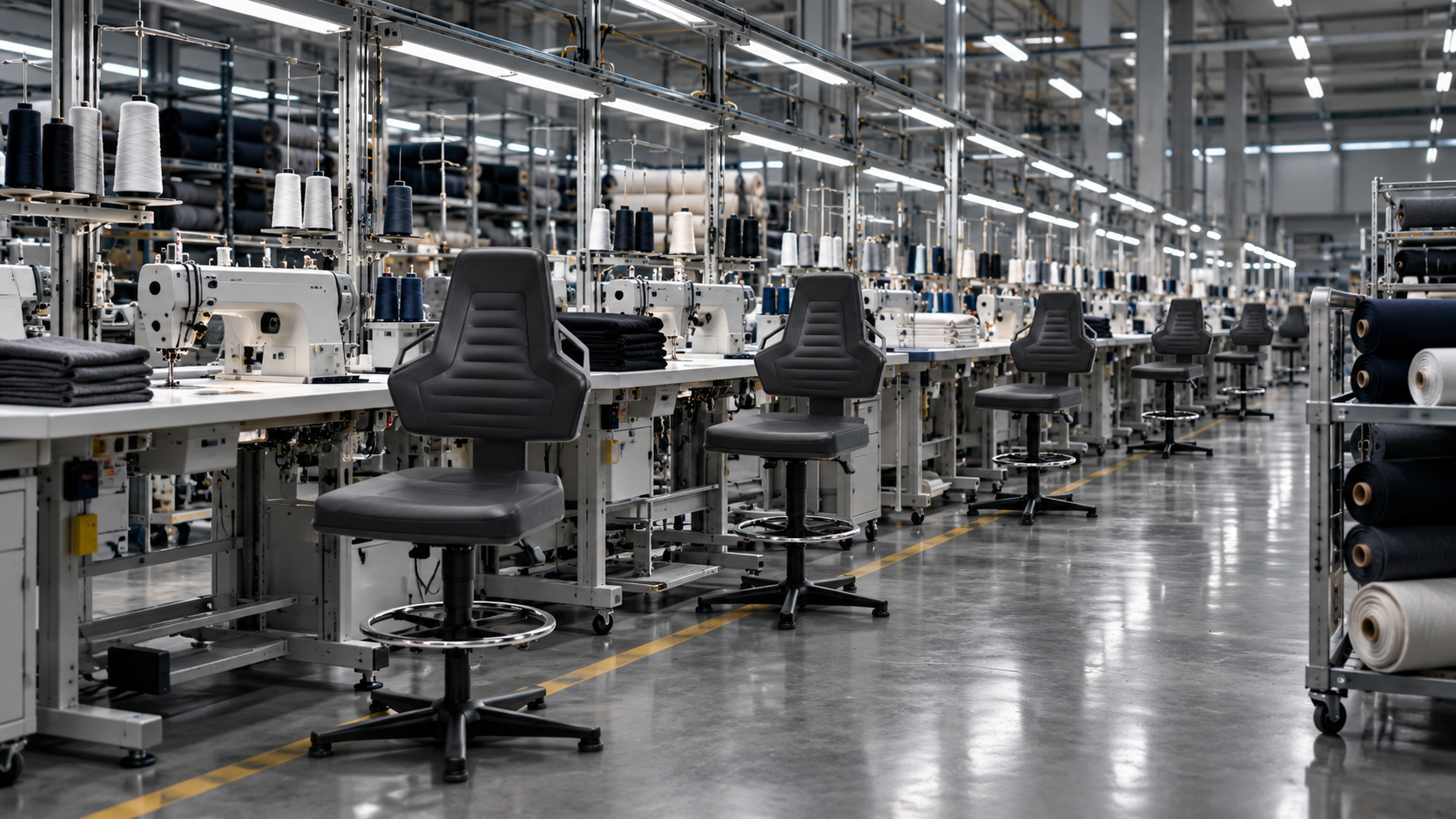
Anyone who has applied these provisions on a plant floor knows they have gaps. Companies should understand them, because they are areas where employers can make mistakes in good faith:
- “When the nature of the work permits.” The law does not say who makes that decision or what criteria they should use. In industry—where most of our readers work—this phrase determines whether an employer is required to provide seats. The only defensible answer is a documented technical assessment for each job.
- When does standing become “prolonged”? The STPS defines it as more than three consecutive hours, and the decision tree says the decree does not apply if standing is not prolonged. But the scoring table assigns the highest value to anyone who stands for more than one hour. The same document contains two different thresholds.
- The low-risk level is nearly impossible to achieve. A score of 7 is required, which means meeting the ideal condition for all seven factors. In practice, almost everyone falls into the medium- or high-risk category, and the provisions do not specify which measures correspond to each level.
- The assessment tool does not measure physical workload. It does not account for force, weight handled, posture angles, or repetition. That is why the Chair Law does not replace NOM-036-1-STPS-2018 on manual handling of loads or a formal ergonomic assessment.
- People who always work seated are left out. As we saw with the four people mentioned earlier, the decision tree excludes them even when they have a real ergonomic risk.
- There is no specific fine. The amendment did not create a separate penalty. Depending on how the authority classifies the violation, it could apply the general fine for violating labor regulations—50 to 5,000 UMA under Article 1002—or the fine for failing to comply with occupational safety and hygiene regulations—250 to 5,000 UMA under Article 994, Section V.
The myth that sitting is healthier
One effect of this law concerns me more than its ambiguities: the increasingly common idea that sitting is healthy and standing is harmful.
In Mexico, that idea lands in a sensitive context. The 2022 National Health and Nutrition Survey found that 38.3% of adults were overweight and 36.9% had obesity—three out of four people. In that context, turning the right to sit into an invitation to spend more hours sitting is not good news for anyone’s health.
The evidence on sedentary behavior is compelling. In 2016, Ulf Ekelund and his team analyzed data from more than one million people in The Lancet. They found that prolonged sitting was associated with a higher risk of mortality, and that only 60 to 75 minutes of moderate physical activity per day eliminated that effect. Very few workers get that much activity in their daily lives.
At the same time, prolonged standing can cause harm: lower back and leg pain, circulatory problems, fatigue, and pregnancy complications. These effects were documented in a review by Thomas Waters and Robert Dick, which the STPS itself cites in its provisions.
So what is the answer? Ergonomic theory has addressed this question for decades. ISO 11226, which evaluates static working postures, puts it simply: work should provide enough variation between sitting, standing, and walking. The problem is not the chair or the floor. It is a posture that never changes.
What the Chair Law makes possible
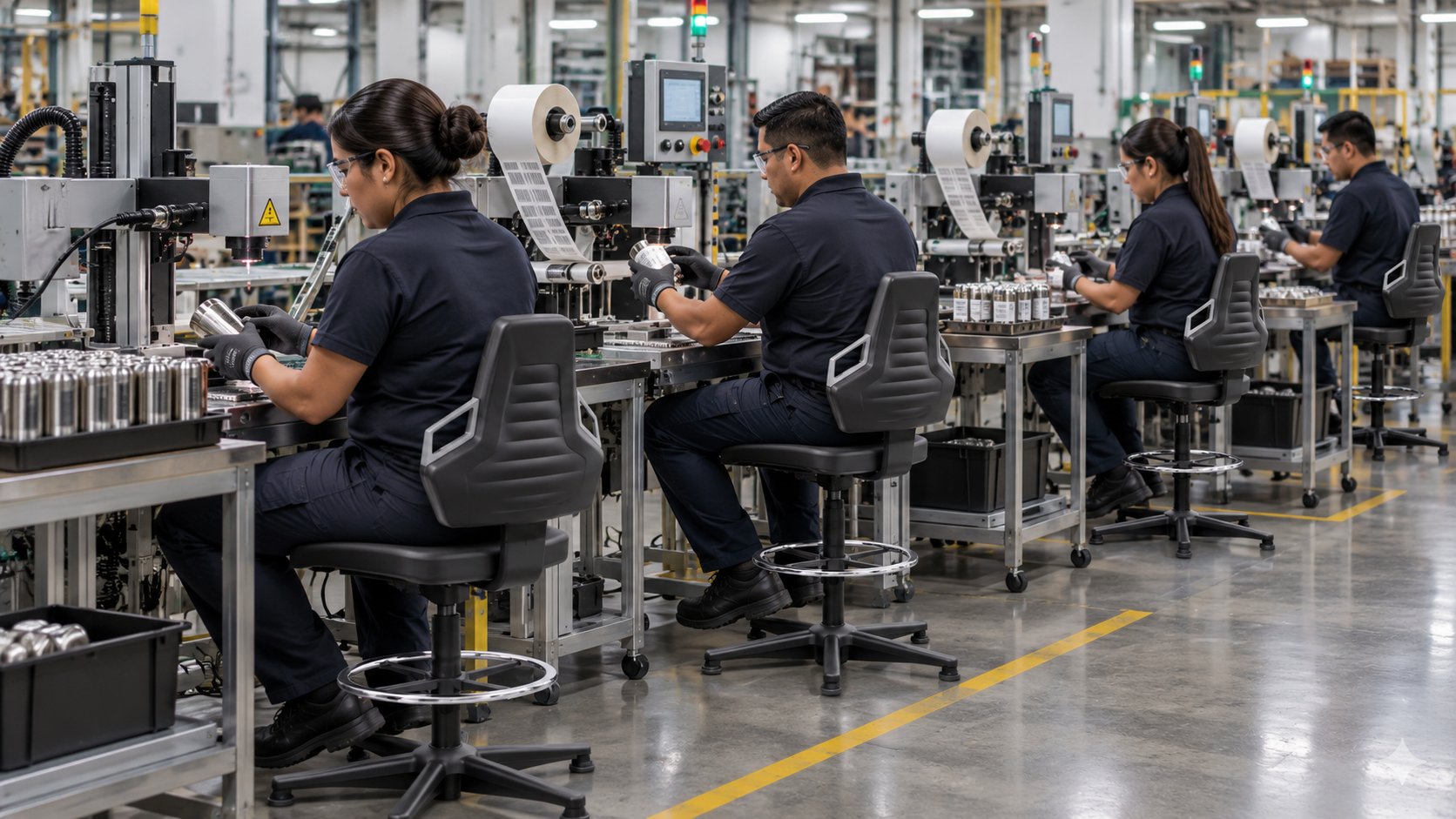
That is why I see this law differently. Above all, the Chair Law is an opportunity to assess workstations: which postures people adopt, how long they maintain them, what loads they handle, how much force they exert, and whether the way work is organized allows them to recover. From there, employers can design conditions that fit the task, its duration, and—most importantly—the person doing it.
Ergonomics offers precise tools for this. ISO 11226 establishes how long a posture can be maintained based on the angles of the trunk, head, and arms. The WR method, described in Technical Prevention Note 847 by Spain’s occupational safety and health institute, can be used to calculate breaks based on muscular effort.
Using Gisela Sjøgaard’s formula, a posture requiring 20% of a muscle group’s maximum force can be maintained for only about nine minutes before recovery is needed. Breaks no longer have to be an arbitrary concession; they can be calculated.
At the plant I mentioned earlier, this approach changed the conversation. The biggest contributing factor was not a lack of chairs; it was the hard floor, which affected 73% of the workforce. Next came informal breaks and footwear that six out of ten people wore even though it was not ergonomic. The highest-impact recommendations were anti-fatigue mats, appropriate footwear, and a break program—not the mass purchase of stools. Chairs were added where they made sense, but they were not the focus.
How to get started at your company
If your plant has not yet put the Chair Law into practice, here is a reasonable seven-step approach:
Behind every survey is a person who spends eight or ten hours doing their job. Working is one of the most worthwhile things adults do. No one should have to pay for that effort with back pain, varicose veins, or a worn-down knee by age 40.
The purpose of the Chair Law is not to hand out chairs. It is to make work more comfortable, reduce ergonomic risks, and prevent musculoskeletal injuries. A well-placed chair can be part of the solution. Good work design always is.
Our services include an assessment using the STPS tool; ergonomic job assessments using postural methods, ISO 11226, and NOM-036-1; break calculations; an action plan; and support for the Joint Safety and Hygiene Commission.
We also provide training for operations and administrative staff on:
- The legal framework of the Chair Law: employer and worker responsibilities.
- Ergonomics and how the body functions at work.
- Human factors and human error.
- Risky postures and their assessment (RULA, REBA, OWAS, OCRA, ISO 11226, and ROSA for office work).
- Standing work and sedentary behavior: active breaks and movement routines.
- Manual handling of loads under NOM-036-1.
- Workstation adjustments and timely reporting of discomfort to the medical department.
Frequently asked questions
What is Mexico’s Chair Law?
It is an amendment to the Federal Labor Law, published on December 19, 2024, and in effect since June 17, 2025. It requires employers to provide seats with backrests to people who work standing and prohibits requiring them to remain standing for their entire shift.
Who does it protect?
People who work standing in service and commercial establishments and similar workplaces. It also applies in industrial facilities when the nature of the work permits.
Does every worker need to be given a chair?
Not necessarily. The STPS provisions call for assessing each person’s risk and providing a suitable seat at their workstation or in a nearby area, alongside other measures such as anti-fatigue flooring, appropriate footwear, task rotation, and breaks.
What happens if a company does not comply?
The amendment did not create a specific fine. Depending on the authority’s interpretation, the general fines under the Federal Labor Law could apply: 50 to 5,000 UMA under Article 1002, or 250 to 5,000 UMA if the violation is classified as noncompliance with occupational safety and hygiene regulations under Article 994, Section V.
Does the Chair Law replace NOM-036-1?
No. The STPS survey does not assess force, loads, or posture angles. If workers manually handle loads, NOM-036-1-STPS-2018 still applies.
Sources
- Decree amending and adding various provisions to the Federal Labor Law (Articles 132, Section V; 133, Section XVII Bis; 422 and 423). Official Gazette of the Federation, December 19, 2024.
- Secretariat of Labor and Social Welfare (STPS). Provisions on Occupational Risk Factors to Ensure the Right to Rest During the Workday for Workers in a Standing Position. Official Gazette of the Federation, July 17, 2025.
- Federal Labor Law, Articles 994 and 1002.
- NOM-030-STPS-2009, NOM-019-STPS-2011, and NOM-036-1-STPS-2018.
- ISO 11226:2000 and Corrigendum 1:2006, Ergonomics—Evaluation of Static Working Postures, Section 3.1.
- National Institute for Occupational Safety and Hygiene (Spain). Technical Prevention Note 847, Evaluation of Static Postures: The WR Method, 2009.
- Sjøgaard, G. “Intramuscular Changes During Long-Term Contraction.” In: Corlett, N.; Wilson, J.; and Manenica, I. (eds.), The Ergonomics of Working Postures. Taylor & Francis, 1986, pp. 136–143.
- Campos-Nonato, I.; Galván-Valencia, O.; Hernández-Barrera, L.; Oviedo-Solís, C. y Barquera, S. «Prevalencia de obesidad y factores de riesgo asociados en adultos mexicanos: resultados de la Ensanut 2022». Salud Pública de México, 2023;65(supl. 1):S238–S247.
- Ekelund, U., et al. “Does Physical Activity Attenuate, or Even Eliminate, the Detrimental Association of Sitting Time with Mortality? A Harmonised Meta-Analysis of Data from More Than 1 Million Men and Women.” The Lancet, 2016; 388(10051): 1302–1310.
- Waters, T. R., and Dick, R. B. “Evidence of Health Risks Associated with Prolonged Standing at Work and Intervention Effectiveness.” Rehabilitation Nursing, 2015; 40(3): 148–165.
- Occupational Hygiene Training Association. Ergonomic Essentials, 2023.