Publication date: September 2026
According to the agency’s own estimates, lockout prevents 122 deaths and 60,000 injuries every year. It is not a prohibition; it is a decision framework with five legitimate pathways. Which pathway applies to a given task? What does NOM-004 actually require compared with international standards? And why is the frequency with which a lock is needed determined by the machine’s design?
It is worth starting with the number, because it is rarely cited and it changes the conversation.
When the U.S. agency established its hazardous energy control standard, it estimated that the standard would prevent 122 fatalities, 28,416 injuries involving days away from work, and 31,926 injuries without days away from work each year. The estimated compliance cost was $214 million in the first year and $135 million annually thereafter.
Sixty thousand injuries and 122 lives saved for $135 million a year. Few industrial safety measures show a relationship like that, and none with documentation of this kind.
Lockout works for a reason that sets it apart from nearly everything else we do in safety: it doesn’t improve behavior; it removes the energy. It doesn’t reduce the likelihood that someone will make a mistake; it makes sure that a mistake has no consequences. It is an energy-isolation control, and its performance does not depend on who is operating the equipment, how tired they are, or how close it is to the end of the shift.
That is why another available finding is so unsettling. A study published in the American Journal of Industrial Medicine, which reviewed investigation records for lockout-related fatalities in U.S. manufacturing, found that lockout procedures were not even attempted in at least 58.8% of cases. The most common situations involved cleaning a mixer, cleaning a conveyor, and disassembling electrical equipment.
People don’t die because they applied the procedure incorrectly. They die while performing tasks for which no one asked which procedure applied.
That is the real problem, and it is not a matter of discipline. The standard is often read as a prohibition, when it is actually a map: five legitimate pathways, each with its own conditions. People who know all five can make the right decision. Those who know only the first end up improvising on the floor.
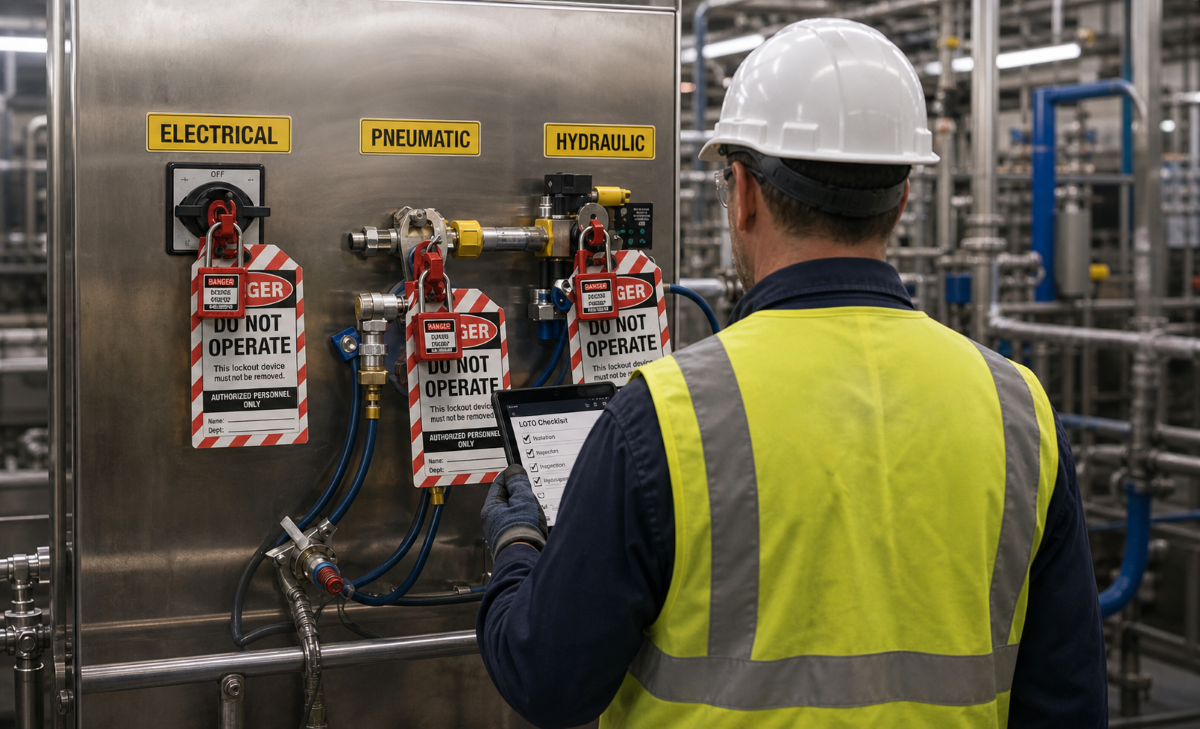
The U.S. figure helps illustrate how the control works; it should not be applied directly to Mexico. The relevant question is how large the problem is here.
A study published in the Revista Médica del Instituto Mexicano del Seguro Social, using data from the 2024 statistical report, provides some context. Among a population of 21.9 million workers insured under the occupational risk insurance program, there were 418,514 work-related accidents—excluding commuting accidents—and 859 resulting deaths. The most frequent injuries included superficial injuries, with 114,606 cases, and wounds, with 71,039.
To be clear, and this is important: no Mexican statistics isolate incidents involving hazardous energy. There is no national figure equivalent to the one behind the U.S. standard. Available classifications group incidents by the nature of the injury and by industry, not by the mechanism that caused them.
This has two consequences, and both are useful.
First, no Mexican plant can compare itself with a national benchmark for this issue. There isn’t one. Second, for that very reason, the only useful measurement is an internal one: how many times per week does someone intervene on a machine that could move or still has residual energy? Every plant has this number, no one tracks it, and it is the only indicator that can anticipate an incident instead of counting one after it happens.
Tracking it for one week costs little and can shape the entire conversation. If the number is high, none of the five pathways below is an administrative matter. Each one describes something happening at that plant every day.
This is the default approach, and its scope is broader than many people assume. The standard’s definition of servicing and maintenance explicitly includes lubrication, cleaning, unjamming, adjustments, and tool changes when a worker is exposed to unexpected energization or the release of energy. An operator cleaning a mixer is performing servicing, even if no one at the plant calls it that.
The sequence has six steps: understand the procedure, shut down the equipment, isolate the energy, apply the devices, release stored energy, and verify isolation. Two details are often overlooked.
First, the standard’s own sample procedure includes an explicit precaution as part of verification: after verifying isolation, return the operating controls to neutral or the off position. If an attempt to restart the equipment remains engaged, the machine may start when power is restored.
Second, verification does not mean trying to start the equipment when the energy source is not electrical. For hydraulic and pneumatic systems, the pressure gauge should read zero; gravity loads need mechanical blocking; fluids require a blocked valve and verified purge.
Some tasks require the equipment to move. The standard does not prohibit them; it provides a sequence for performing them. It allows the devices to be temporarily removed through a five-step process: clear tools and materials, move personnel away from the danger zone, remove the devices, energize the equipment and conduct the test with effective safeguards in place, then isolate the equipment again and reapply the devices.
The electrical standard requires the same process under a different name—temporary release for testing or positioning—and adds a requirement worth adopting: the procedure must identify who is responsible for each step. In practice, assigning that responsibility by name is what keeps a temporary release from becoming a permanent one.
This is the question I hear most often at plants, and the official answer is more nuanced than people often say.
The U.S. agency holds that observing whether equipment is functioning properly counts as inspection and is therefore considered servicing or maintenance. Troubleshooting is covered by the standard; it is not outside its scope. And yet, it can still be performed—through the testing and positioning pathway, with personnel outside the danger zone.
When that is not possible—because the point that needs to be observed can only be seen from inside the zone—the agency identifies controls that can make it possible: two-hand controls, physical restraints on the worker, cameras, and transparent physical barriers.
In other words, observing a process while it is running is legitimate when an engineering control prevents contact. Attention alone is not enough.
This is the provision people invoke most often and understand least. It excludes minor servicing activities from the standard’s scope when they take place during normal production, provided they are routine, repetitive, integral to the productive use of the equipment, and performed using alternative measures that provide effective protection.
These are four cumulative requirements. On the floor, people cite the first and dismiss the other three.
The fourth is the deciding factor. An alternative measure does not mean experience, training, or caution. It means a control that physically prevents energization or movement during the task: an interlock, a two-hand control, a mechanical block, or a presence-sensing device. Applied to the mixer, the test is straightforward: if the lid has no interlock, there is no alternative measure—and without an alternative measure, the exception does not apply.
When full lockout is not feasible for a particular task, alternative methods may be an option. These are described in detail in the U.S. voluntary standard on the subject. There is an important point here that few people in Mexico know—and overlooking it can be costly.
In an October 2024 interpretation, the agency declined to adopt that voluntary standard’s definition of alternative methods. It also stated that it had not determined that compliance with the voluntary standard would, in every case, meet its own requirements.
For a Mexican plant whose corporate headquarters implemented alternative methods on that basis, the consequence is direct: the plant may believe it complies with the reference standard even though the agency responsible for that standard says otherwise. The same issue can be seen with European hazardous-area classifications and Mexico’s current framework: adopting a foreign standard does not, by itself, establish compliance.
The electrical safety standard for the workplace adds what the general standard lacks: precision about what it means for a circuit to be truly de-energized. It does so through a concept worth adding to the vocabulary because it changes how we think about the problem.
It does not define a procedure. It defines a condition: an electrically safe work condition.
The standard sets out nine steps for achieving this condition, in the order presented whenever possible. Identify all possible sources of supply using up-to-date diagrams. After properly interrupting the load current, open the disconnecting devices. Visually verify that all blades are fully open or that draw-out circuit breakers have been moved to the test or fully disconnected position. Release stored electrical energy. Block or relieve non-electrical energy. Apply the devices according to a documented procedure. Test for the absence of voltage. Apply protective temporary grounding where required.
The seventh step deserves a closer look. Testing must be performed with a portable instrument appropriate for the application, on every phase conductor and at every work point, both phase to phase and phase to ground. And—and this is what is most often overlooked—the instrument must be checked against a known voltage source both before and after testing.
A multimeter that fails during the test would show the same result as a de-energized circuit. That is why it is checked twice.
The standard adds that if the absence of voltage alone does not confirm that the circuit is de-energized, additional methods are required, such as testing for the absence of current in current-fed circuits.
The same standard provides three rules worth carrying over as written into any Mexican procedure:
Push buttons do not isolate energy. Control devices such as push-button stations and selector switches must not be used as the primary means of energy isolation. This is a clear way to describe a mistake that happens every day.
Circuit interlocks must be reviewed. Documentation must be examined to make sure that no electrical interlock operation could re-energize the circuit being serviced.
If it cannot be locked, it cannot serve as isolation. When a lock cannot be attached to an existing disconnecting means, that means must not be used as the sole method of establishing a safe condition. Tagout without lockout is allowed only when the equipment’s design prevents a lock from being installed. In that case, at least one additional safety measure must be used.
What happens when an electrically safe work condition cannot be established? The standard provides a pathway, but with demanding conditions: qualified personnel only; an energized electrical work permit; an electric shock risk assessment; and an arc flash risk assessment. If the permit specifies protective equipment, at least one additional person must be present outside the limited approach boundary or the arc flash boundary, whichever is greater.
Everything described above refers to standards that are not mandatory in Mexico on their own. A plant manager will naturally ask: What does Mexican law actually require?
More than many people assume, and less than is needed.
NOM-004-STPS contains a lockout sequence. It appears in section 7.2.2(c), and almost no one cites it.
The standard requires energy to be locked out before and during machinery and equipment maintenance, and lists eight steps: the maintenance supervisor performs the lockout; workers are notified in advance; the switches and valves to be immobilized are identified; energy is locked out at panels and controls; warning tags are applied in accordance with Appendix A; safety locks are applied; lockout is verified; and workers are notified when the lockout is removed.
Existe, pues, una obligación mexicana concreta y con secuencia. El problema no es su ausencia: es lo que la secuencia no dice.
NOM-029-STPS addresses the electrical component. It requires verification of the absence of voltage using testing equipment or instruments, instructions for locking out equipment or applying warning signs, locks, or devices that prevent energization, and—an important detail—the identification of lockout devices for one to four locks. In other words, the Mexican framework does account for multiple locks being applied to a single isolation point, which is the basis of group lockout.
NOM-028-STPS also lists lockout and tagout among the activities that require a written procedure and authorization, along with locking out electrical power lines and pipes containing hazardous or pressurized substances.
There is also a valuable point of alignment with the fourth pathway. When NOM-004 addresses the risks associated with manually feeding and removing material, it names the acceptable controls: a two-hand control device, a device associated with a guard, or a presence-sensing device. These are exactly the alternative measures required by the minor servicing exception. The Mexican standard already names the solution; what it does not do is connect that solution to the decision about when a lockout device may be omitted.
There is also a structural difference, not just a difference in detail. The Mexican sequence assigns lockout to the maintenance supervisor. International standards assign it to each exposed worker, who applies and removes their own lock. These are two different protection philosophies: one delegates responsibility to a competent third party; the other makes sure no one has to rely on someone else’s memory. When a plant with foreign corporate headquarters adopts personal lockout, it is not going beyond the Mexican standard. It is closing the gap between the two approaches.
The right approach for a Mexican plant is therefore not to choose between frameworks. It is to comply with NOM-004 and NOM-029, which are mandatory, and supplement them with international requirements wherever the national framework leaves gaps. Stating this clearly in the procedure, with each requirement and its corresponding reference, makes it possible to defend the program before both a labor inspector and a corporate auditor.
Everything above describes what to do with an existing machine. The more valuable question comes first: Why is it necessary so often?
The international standard on the prevention of unexpected start-up addresses this directly. It states that machines must be equipped with manual energy-isolation and energy-dissipation devices designed with the task in mind. It adds:
> If manual isolation and energy dissipation are not appropriate for short, frequent interventions, the designer must provide additional controlled automatic functions to prevent unexpected start-up.
Read that alongside the figure at the beginning of the article. Fatalities are concentrated in tasks that are short, frequent, and familiar. The machinery standard says, in mandatory language, that for these tasks, a manual lockout device is not the right measure. The designer is responsible for solving the problem another way.
The next paragraph explains why. These measures are intended to prevent operators from being pushed toward hazardous operating modes and intervention techniques because of technical difficulties in using the machine. An engineering standard is stating plainly that poor design can encourage unsafe behavior.
The same standard addresses a detail everyone knows and no one questions. The number and location of isolation devices must be determined through a risk assessment that considers the task and whether people need to be in danger zones. The device can be located at the point of intervention or along the access route.
A disconnect switch located 12 meters away is not an unavoidable fact of life. It is a decision someone made—and it can be made differently.
The 2024 edition of the standard on interlocking devices associated with guards closes the loop with a chapter titled Design to Minimize the Motivation to Defeat. Its rule is that interlocking devices should interfere as little as possible with work activities—especially during maintenance and servicing—to reduce the incentive to bypass them. When that incentive exists, the standard calls for eliminating it through design or appropriate operating modes, with operating modes taking precedence. The modes it lists include adjustment, tool changes, troubleshooting, and process observation.
In other words, the standards-based response to an operator who bypasses an interlock to see what is happening is not to discipline or train the operator. It is to provide an operating mode designed for that task.
There is also a design requirement every equipment buyer should keep in mind: energy-isolating devices installed after January 2, 1990, must be capable of accepting a lockout device. This is not just a recommended practice. It is a requirement, and it applies to equipment being quoted today.
All of the above points to an indicator that appears on no dashboard but describes a plant’s technical maturity better than its injury rate:
How often a lockout is needed is an inverse indicator of machine design quality.
A machine with accessible isolation points, interlocked access points that do not get in the way, modes designed for troubleshooting and observation, and a cleaning setup that does not require workers to reach inside will need to be locked out less often. And when lockout is required, the procedure will be brief enough that people will actually follow it.
That is where safety stops competing with production. As long as compliance takes more effort than noncompliance, every procedure is at odds with the pace of the production line—and at 3 a.m., the procedure loses. When compliance is the easier option, behavior no longer has to serve as the critical control.
Ciento veintidós vidas al año dependen de una lámina metálica que cuesta unos pesos y de treinta segundos de trabajo. Que esos treinta segundos ocurran o no ocurran se decidió mucho antes, en la mesa donde alguien especificó la máquina.
At HF Safety & Environmental Services, we develop hazardous energy control programs based on equipment-specific risk assessments. These programs include machine-specific procedures, task evaluations using the five decision pathways, verification based on energy type, and reviews of the accessibility and design of isolation points. If your program was written for scheduled maintenance, it may be time to review what happens during normal production.
Can a machine be observed while it is running to troubleshoot a problem?
Yes. This is a recognized pathway. Observing whether equipment is functioning properly is considered inspection and therefore servicing, so it must be done through the testing and positioning pathway, with personnel outside the danger zone. When that is not possible, engineering controls may be used, including two-hand controls, physical restraints, cameras, or transparent barriers.
Does cleaning equipment between production runs require lockout?
It depends on four cumulative conditions: the task must be routine, repetitive, integral to production, and performed using alternative measures that provide effective protection. Without an alternative measure—such as an interlock, mechanical block, or presence-sensing device—the full procedure is required.
Can a stop button be used for energy isolation?
No. Control devices such as push-button stations and selector switches must not be used as the primary means of energy isolation. And if a lock cannot be attached to a disconnecting means, it must not be used as the sole method of establishing a safe condition.
Are there Mexican statistics on hazardous energy incidents?
Not in a disaggregated format. National sources record work-related accidents by the nature of the injury and by industry—418,514 accidents and 859 deaths in 2024 among 21.9 million insured workers—but do not isolate hazardous energy as the cause. In the absence of that data, the useful measurement is an internal one: how many times each week do workers need to access a machine that could move or still has residual energy?
Does Mexican law require lockout/tagout?
Yes. Section 7.2.2(c) of NOM-004-STPS establishes an eight-step energy lockout sequence for maintenance, before and during the work, including warning tags and safety locks. NOM-029-STPS adds verification that voltage is absent and lockout devices for multiple locks. NOM-028-STPS requires a procedure and authorization.
The national framework does not address stored energy, energy-specific verification methods, group lockout, shift-to-shift transfer, or periodic procedure inspections in detail.
Why doesn’t a lockout device solve short, repetitive tasks?
Because it was not designed for those tasks. The international standard on the prevention of unexpected start-up states that when manual isolation is not appropriate for short, frequent interventions, the designer must provide additional controlled automatic functions. It is a machine design issue, not an operator discipline issue.

Todos los Derechos Reservados 2026